Should curtains cover a radiator? What I'd do to a cold room instead
Search how to heat a cold room and you'll be told to shorten your curtains so they clear the radiator. I'd never do that. Sill length curtains hanging over a radiator look mean, and they date a room the second they go up. The better answer is to move the curtains rather than cut them: hang a Roman blind inside the window recess to do the thermal work at night, and hang full length curtains outside the recess, stacked either side of the window, where they're nowhere near the radiator. Then deal with the draughty external door, put wool rugs down on any stone or tile, and warm the person as well as the room.
That's the order I'd work in, and none of it is the boiler.
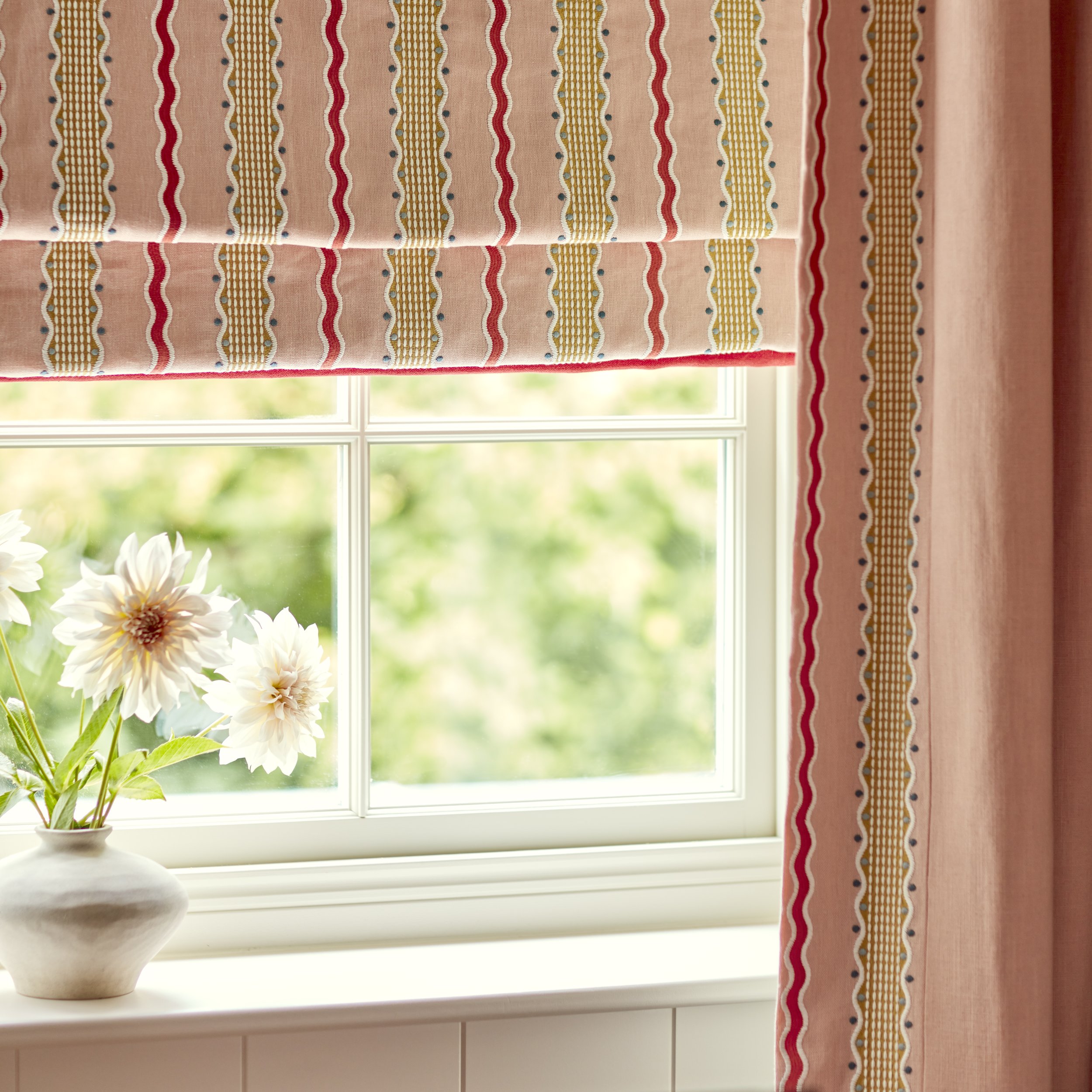
A blind inside the recess, curtains hanging outside it. Photo: Linwood Fabric. Fabrics: Hermia in Peony, and Titania.
Why shortening your curtains is the wrong fix
The advice isn't nonsense. If a full length curtain hangs directly in front of a radiator and you close it, you do trap the heat between the curtain and the glass, and a fair bit of it goes out of the window. That part is true.
The problem is the solution. Shortening the curtains fixes the radiator and leaves you sitting in a room that now looks wrong. Sill length curtains cut the window off halfway, they make the ceiling feel lower, and they read as dated the moment they're hung. You've traded the look of the room for a few degrees, and you'll be looking at that window every day for the next ten years.
There's a version where you keep both, and it just takes hanging things in a different order.
What to do at the window instead
Put a Roman blind inside the recess. That's the thing that closes at night against the glass, and it's doing the thermal job.
Your curtains then hang outside the recess, on a pole wider than the window, so when they're open they stack either side of the opening rather than across it. Hung that way they're not in front of the radiator at all, which means the objection disappears and you keep the full length.
Two details that matter more than people expect. It's the interlining that does the work, not the weight of the fabric, so ask for interlined curtains rather than reaching for the heaviest cloth in the book. And the curtains need to return to the wall at the ends, so there's no gap at the side for cold air to fall through.
Start with the door, not the window
Before any of that, look at your external doors.
Older houses round here nearly always have a door opening straight into a room, and it's the coldest corner every time. Sort the door itself first: a brush strip along the bottom, draught excluder round the frame. That's an afternoon's work and it costs very little.
Then hang a heavy interlined curtain across the door on a swing arm, so it swings clear when you open the door and falls back across it when you don't. This is the single biggest difference in most cold rooms and it's the thing nobody does.
Rugs on stone and tile
Hard floors pull the warmth out of a room, and a cold floor makes the whole space feel colder than the thermometer says.
Wool, and big enough that the furniture sits on the rug rather than round it. A rug that's too small does almost nothing, either for the temperature or for how the room looks.
Something patterned with a bit of patina is worth considering if the room gets used, because it hides muddy paws and dropped toast.
Warm the person, not just the room
A heavy wool blanket over the arm of the sofa you actually sit on. Lamps on in the evening instead of the big light.
Neither of those changes the temperature by a single degree. Both change how cold the room feels, and that's the bit that matters when you're sat in there in February.
If the room is also north facing, it's worth reading what colour to paint a north facing room alongside this, because cold light and cold air compound each other and the paint is doing some of the same work.
What does it actually cost to work with an interior designer?
I've written a guide that gives you the real numbers: what a room costs, what a whole house costs, and what you're paying for at each stage. No ranges so wide they tell you nothing.
You'll also get my Sunday letter, where I write about one room at a time, usually whatever I'm in the middle of at home.
Common questions
Do curtains over a radiator waste heat? Yes, if they hang directly in front of it and you close them. The heat gets trapped between the curtain and the glass. The fix isn't to shorten the curtains though, it's to hang them outside the window recess so they stack either side and sit clear of the radiator.
Should curtains be floor length or sill length? Floor length in almost every room. Sill length has its uses, usually in a kitchen or over a deep sill you need access to, but as a heating measure it costs you more in how the room looks than it gives you back in warmth.
Does interlining actually make a difference? It's the layer that does the insulating, so yes. A lined curtain in a heavy fabric will do less than an interlined one in a lighter cloth.
What's the cheapest thing to do to a cold room? Draught proof the external door. Brush strip and draught excluder, an afternoon, very little money, and in most older houses it's the biggest single gain available.
If there's one room in your house that's cold every winter and you're at the point of ordering curtains for it, book a free 15 minute intro call and we'll talk about working together on it.