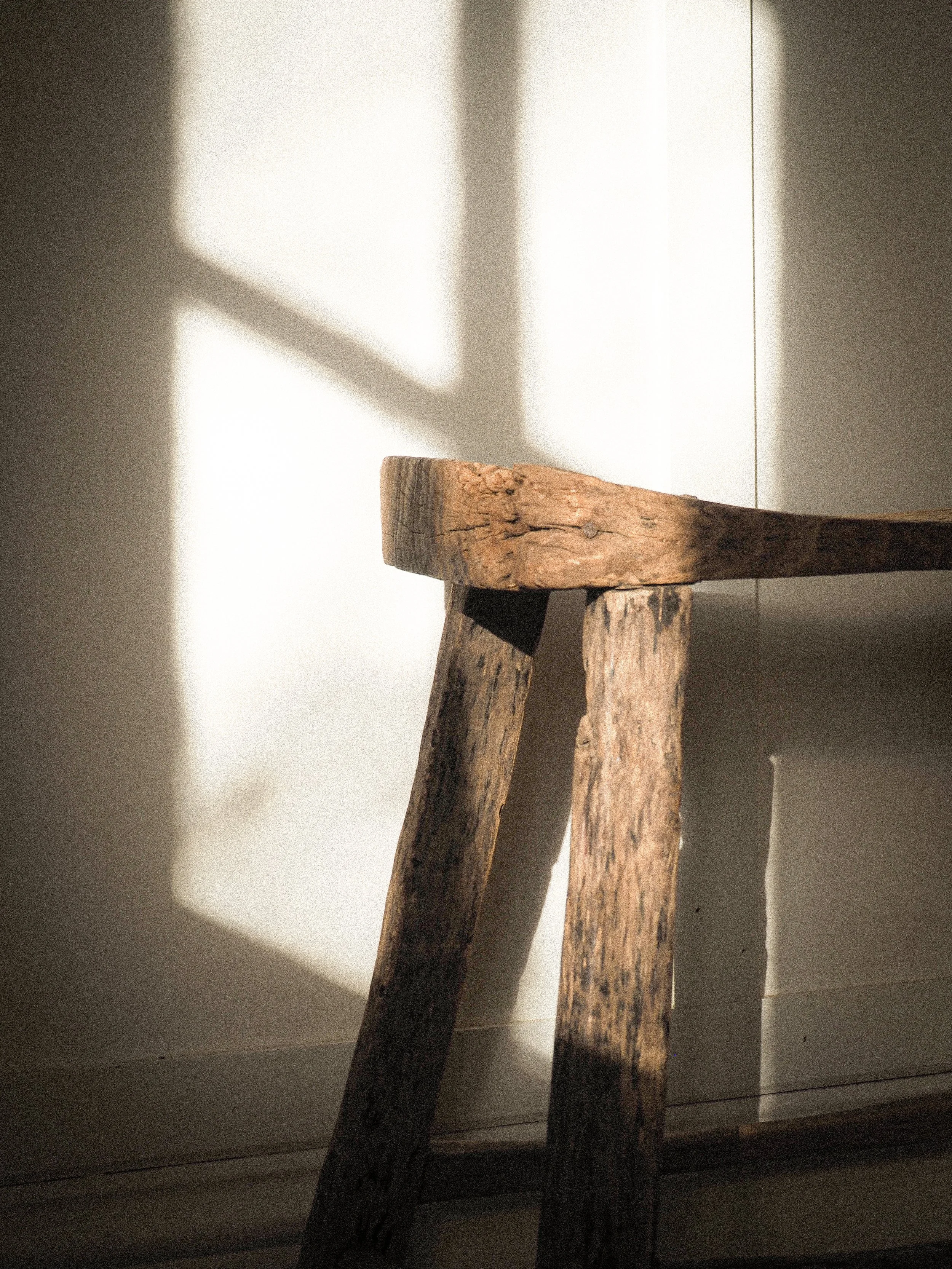
Dark wood against a pale wall. High contrast, meaning it reads as something placed rather than something that came with the room.
Antiques work in a modern home when you use them rather than display them. The best place for an old piece is usually a job you were going to buy something new for anyway: a box on the coffee table that the remotes live in, a little table in the downstairs loo, a chest that holds the spare bedding. The piece earns its place by being useful, and you've swapped something picked up in John Lewis for something with a story behind it. Whether it sits happily alongside your newer things comes down to tone and contrast rather than period. Period doesn't need to match anything else in the room. Colour does.
Use them, don't display them
The mistake I see most often is treating an antique as art. It gets a clear wall, a pool of empty floor and nothing allowed near it, and the whole room ends up slightly reverent.
Old furniture was made to be used. A table that's taken a hundred years of dinners is not going to be upset by your keys and a cup of tea. The wear it already has is most of why you liked it.
So put it where you'd have put the new thing. If the room needs somewhere to drop post, buy an old thing that does that. If it needs a box for the remotes, buy a lovely old box. You're not adding an antique to the room, you're elevating something the room already needed.
Start small, and somewhere unexpected
Most people's first antique is too big a commitment, which is why it sits in a shop while they think about it.
Start with the small useful things. A little table in the downstairs loo, where nobody expects anything at all and it becomes the only interesting thing in there. A box for the remotes. An old tray. A set of hooks. Brass candlesticks that get used rather than kept for best.
They cost less, they're easier to move if they don't work, and they do more for a room than their size suggests, because they're the things people pick up and ask about.
What if it doesn't match anything you own?
It doesn't have to. That's usually the fear underneath the hesitation, and period has very little to do with whether a piece settles into a room. Tone and contrast do most of the work.
Decide first whether you want the piece to stand out or sit back. A dark walnut chest against a pale wall is high contrast, so it reads as something you've deliberately placed. The same chest against a deep green wall almost sinks into it, and the room feels calmer for it. Neither is wrong, but it helps to know which one you're doing before you buy the paint.
Then look at undertone. Warm woods sit happily against warm neutrals and can start to fight against cool greys, which is the same reason warm colours work better in a north facing room. An old oak table doesn't argue with a new sofa because one of them is old. It argues because one is warm and the other is cool.
The practical version: your walls are already painted, so judge the piece against them rather than the other way round. A photo of the room on your phone is enough when you're out looking. If you happen to be redecorating anyway, then buy the piece first and choose the colour around it.
And the bigger pieces
Not everything has to be small. When a large antique is right it's very right, and these are the three I'd buy tomorrow.
A refectory table in a big heritage kitchen. Think deVOL: a range, handmade cupboards, stone or tile underfoot. Long tables can look wrong in a small room and wonderful in a large one, plus they get better the more they're used.
An old tapestry in a modern farmhouse scheme. Cream walls, natural wood, a few iron details, Crittall doors if you've got them. That look goes flat faster than any other, and a large piece of antique textile fixes it, because it brings in colour and age without fighting anything.
A navy office chair in a dark and moody office. Wood, leather, a decanter of whisky on the sideboard. Navy can sound like a safe choice until you see it against that kind of backdrop, and then it's the thing that lifts the whole room.
Why buy an antique rather than something new?
It's usually better made than anything new at the same price. A second-hand oak table that's survived a hundred years of dinners is a different object from a new one built to arrive flat-packed.
It's already had one life, so nothing had to be made or shipped for you to have it. You're giving it the next chapter rather than starting one from scratch.
And in a good antiques shop somebody has chosen every piece in there. There's a person behind it who knows what they've got, which is not true of a warehouse.
What to check before you buy
Be honest about whether you'd use it. This is the one that matters, and it's where most second-hand buying goes wrong, because somebody falls for an object rather than a thing they actually need.
Measure the room, then the piece, then the doorway. Old furniture was made for rooms with different proportions and it is routinely bigger than it looks in a photograph.
Ask what's been done to it. Repairs, replaced feet, a refinished top. None of those are necessarily a problem, but they affect the price and you want to know.
Buy locally if you can
I'd always rather our money went to a local dealer than to a big retailer, and Derbyshire has plenty of good ones.
It's also easier. You can see the piece, measure it, look at the back of it and ask what's been done to it, none of which you can do from a listing. And the person selling it will usually tell you where it came from, which you don't get anywhere else.
Buying second-hand can feel like more effort than ordering something new, and sometimes it is. But the pieces people comment on in a finished room are almost never the new ones.
What does it actually cost to work with an interior designer?
I've written a guide that gives you the real numbers: what a room costs, what a whole house costs, and what you're paying for at each stage. No ranges so wide they tell you nothing.
You'll also get my Sunday letter, where I write about one room at a time, usually whatever I'm in the middle of at home.
Common questions
Can you mix antique and modern furniture? Yes, and it usually looks better than a room of all one or the other. What makes it work is tone and contrast rather than period: whether the piece is lighter or darker than what's behind it, and whether the undertones are both warm or both cool.
How many antiques should one room have? There's no number. A room can be full of old things and look wonderful. What causes trouble is buying a second and a third piece to make the first one feel settled, because the problem usually isn't the piece, it's where it's sitting.
Do antiques work in a new build? They work very well. A new build gives you plain walls and clean lines, and an old piece is the quickest way to stop a new house feeling like it came out of a box.
What's a good first antique to buy? Something small that does a job. A box, a tray, a little side table, a set of candlesticks. It costs less, it's easy to move if it doesn't work, and you'll use it every day, which is the whole point.
Are antiques cheaper than new furniture? Often, for the quality you get. A second-hand piece of solid wood furniture frequently costs less than a new one of similar size, and it's usually better made. Prices vary enormously by period and by dealer, so it's worth looking at a few before you decide what something should cost.
How do I know if an antique is good quality? Look at how it's put together rather than at the surface. Solid wood rather than veneer over board, joints that are cut rather than stapled, and drawers that still run. A refinished top or a repair isn't a problem in itself, but ask so you're paying the right price.
If you've bought something you love and you're not sure what goes around it, that's exactly the job a Room Design does. One room, the whole scheme, so everything else earns its place next to it. If there's a room you've stalled on, book a free 30 minute intro call and we'll talk about working together on it.